

Overview
Since its inception in 2002, Level 1 of the National Certificate of Educational Achievement (NCEA) has required students to meet literacy and numeracy requirements.
This paper outlines the history of the literacy and numeracy requirements for NCEA as well as examining the design and impacts of the current dedicated co-requisite standards. We also analyse participation and achievement data and trends, and integrate insights gleaned from NZQA's co-requisite quality assurance checks.
The findings from this analysis suggest that the co‑requisite assessments have largely achieved their intended role: providing a nationally consistent, curriculum‑aligned mechanism for assuring foundational literacy and numeracy capability within NCEA.
Download this paper as a PDF
On this page
About the standards and the assessments
Prior to the introduction of the dedicated literacy and numeracy co‑requisite standards, students could meet NCEA literacy and numeracy requirements through a wide range of achievement and unit standards. While this flexibility supported diverse pathways, it also resulted in variability in how foundational literacy and numeracy capability was evidenced and understood across the system.
Concerns emerged over time that this approach did not provide a sufficiently clear, consistent, or trusted signal of students’ functional literacy and numeracy capability at the point of qualification. In response, the Ministry of Education introduced dedicated co‑requisite standards to establish a nationally consistent benchmark aligned to curriculum expectations and to strengthen confidence in NCEA outcomes.
Since 2023, the six dedicated literacy and numeracy co-requisite standards, developed by the Ministry of Education, have been the recommended option for students to meet the Literacy and Numeracy requirements for NCEA qualifications. Three of the standards (Reading, Writing and Numeracy) are derived from the New Zealand Curriculum (NZC). The remaining three (Te Reo Torohū, Te Reo Whakaputa and Pāngarau) are derived from Te Marautanga o Aotearoa (TMoA) [1].
Assessments against the standards are developed and marked by NZQA. Assessments were piloted at a small number of selected schools and tertiary providers in 2021, and in a self-selected pilot in 2022 (which had over 200 providers participating). The assessments were independently evaluated in 2022 to assure their quality and fitness for full implementation. At the time of piloting, NZQA used student data from the Ministry’s e-asTTle tool as a check on whether our assessments were levelled at the appropriate curriculum level. Our checks confirmed this [2].
Students receive either an Achieved or Not Achieved grade for each standard. NZQA uses a combination of automated machine marking, automated text scoring and human marking to reduce the time it takes to mark the assessments and return results to students.
[1] In 2022 and 2023, there was only one Te Reo Matatini standard of 10 credits with reading, writing and oral components. From 2024, this single standard was replaced with two 5 credit standards - Te Reo Torohū and Te Reo Whakaputa.
[2] The e-asTTle scores provided an indication of the level of the curriculum participating students were working at. We found that the group of students who were put forward for the assessments with e-asTTle scores below the minimum recommended curriculum level (4P (Proficient) or below) had very low achievement rates, and those with e-asTTle scores at or above the minimum recommended level (4A Advanced or above) had high achievement rates.
What distinguishes the co‑requisite assessment model
The co‑requisite assessment model has a number of features that distinguish it within the New Zealand assessment landscape, including:
- National consistency: Externally developed and marked assessments, common conditions, common judgements.
- Curriculum alignment: Benchmarking to upper Level 4 / lower Level 5 NZC and TMoA, ensuring functional capability rather than subject‑specific depth.
- Multiple opportunities to achieve: More than one assessment event each year; ability to re‑attempt.
- English‑medium and Māori‑medium pathways run in parallel: Six standards created to give equal pathways, based on NZC and TMoA.
What the data shows
The following sections describe participation and achievement patterns as well as insights derived from NZQA's co-requisite quality assurance checks, which together help illustrate how the co‑requisite model is operating in practice.
Participation
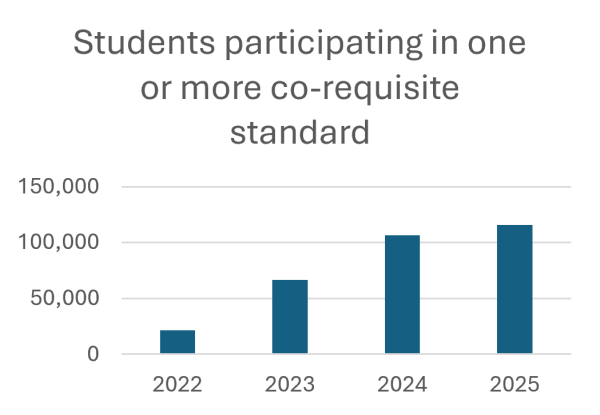
Since 2022, approximately 231,000 students have participated in one or more of the co-requisite assessments at least once. The Numeracy assessment had the most students participate since 2022 – around 213,000. Figure 1 shows the increase in student participation between 2022 to 2025.
Figure 1: Number of students participating in one or more of the six co-requisite assessments, 2022 - 2025
Text description of Figure 1
Graph showing the number of students participating in one or more co-requisite standard.

In 2022, a total of 21,535 students participated in one or more co-requisite standards.

In 2023, a total of 66,674 students participated in one or more co-requisite standards.

In 2024, a total of 106,707 students participated in one or more co-requisite standards.

In 2025, a total of 115,584 students participated in one or more co-requisite standards.
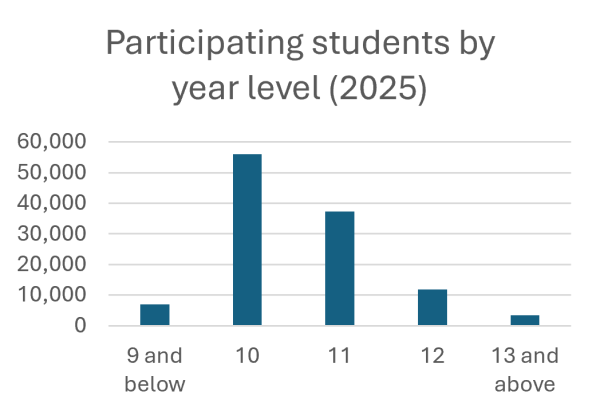
Figure 2 shows the year level distribution of participating students in 2025.
Figure 2: Year level of 2025 students participating in one or more of the six co-requisite assessments
Text description of Figure 2
Graph showing the number of students participating in co-requsite standards by year level in 2025.

6,989 students in Year 9 and below participated in co-requisite standards.

56,071 Year 10 students participated in co-requisite standards.

37,377 Year 11 students participated in co-requisite standards.

11,762 Year 12 students participated in co-requisite standards.

3,379 students in Year 13 and above participated in co-requisite standards.
Nearly half of all participating students (49%) were in Year 10, a third in Year 11 (32%), and 10% in Year 12. Year groups outside of Years 10 to 12 accounted for the remaining 9%.
Year 10 is the point that most students attempt the co-requisite for the first time. In 2025, 75% of enrolled Year 10 students participated in one or more co-requisite assessments.
Almost all schools offering NCEA (97%) provide opportunities for their students to participate in the co-requisite assessments. Event 1 (held in May each year) has more students participating than Event 2 (held in September each year). Many students sit one or more assessments in both events.
Te Reo Torohū, Te Reo Whakaputa and Pāngarau participation
The number of students participating in these assessments is small but growing. Around 1,100 students participated in at least one assessment in 2024, increasing to 1,700 participating students in 2025.
Participating students come from Kura Māori [3], Rumaki units (immersion units within English-medium schools where students are taught at least half their curriculum in Te Reo Māori) and English-medium schools. Students at Kura Māori providers accounted for 72% of students taking Te Reo Torohū, Te Reo Whakaputa and Pāngarau assessments. Table 1 below provides the numbers by school type for 2025.
Table 1: Number and proportion of students by school type (Kura Māori providers, Rumaki and English-medium schools)
| School type | Students (n) | Proportion |
| Kura Māori | 1,194 | 72% |
| Rūmaki Units | 331 | 20% |
| English-medium Schools | 144 | 8% |
[3] Te Runanga Nui o Ngā Kura Kaupapa Māori o Aotearoa, and Ngā Kura a Iwi affiliated kura.
Achievement
Method
We looked at students who had met the NCEA literacy and numeracy co-requisite requirements by the end of Year 11, and what proportion met them by achieving the dedicated co-requisite standards as opposed to the additional list of standards or other restricted eligibility methods [4].
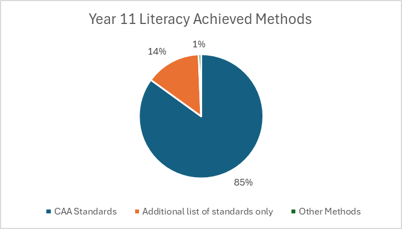
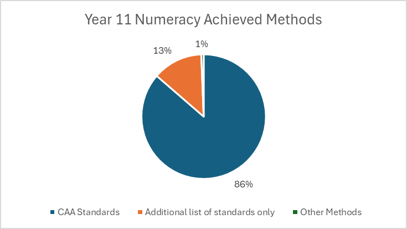
In 2025, more than 85% of students met requirements for both literacy and numeracy through the co-requisite standards, an indication that the Ministry of Education’s recommended approach for meeting the NCEA co-requisite has been well embedded.
Figure 3: Methods 2025 Year 11 students who achieved literacy used to meet the NCEA literacy co-requisite requirement
Text description of Figure 3
Pie graph showing how students achieved the NCEA Literacy requirement by the end of Year 11.

85% of students had used the Common Assessment Activity standards.

14% of students had used the additional list of standards.

1% of students had used other methods.
Figure 4: Methods 2025 Year 11 students who achieved numeracy used to meet the NCEA numeracy co-requisite requirement
Text description of Figure 4
Pie graph showing how students achieved the NCEA Numeracy requirement by the end of Year 11.

86% of students had used the Common Assessment Activity standards.

13% of students had used the additional list of standards.

1% of students had used other methods.

[4] A list of the additional and restricted eligbility standards can be found here: Standards approved for NCEA Co-requisite during the transition period (2024-2027) | NCEA
Achievement rates
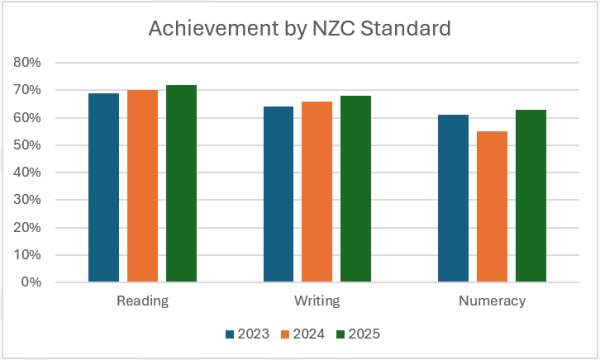
We calculate annual achievement rates for the co-requisite assessments. Where a student was assessed in both Event 1 and Event 2, only the last result is counted. Annual achievement rates across Reading, Writing and Numeracy assessments since 2023 have seen a general upward trend – see Figure 5.
Figure 5: Annual achievement rates for the Reading, Writing and Numeracy standards, 2023 - 2025
Text description of Figure 5
Graph showing achievement for each of the New Zealand Curriculum co-requisite standards.

For the Reading standard, 69% of students achieved in 2023, 70% of students achieved in 2024, and 72% of students achieved in 2025.

For the Writing standard, 64% of students achieved in 2023, 66% of students achieved in 2024, and 68% of students achieved in 2025.

For the Numeracy standard, 61% of students achieved in 2023, 55% of students achieved in 2024, and 63% of students achieved in 2025.
Results by Equity Index Group have also improved over time. However, there are significant differences in attainment which are illustrative of the inequity of outcomes within senior secondary schooling. In 2025, attainment in Numeracy for students at schools with fewer socio-economic barriers to attainment was double that for students at schools with more socio-economic barriers to attainment (80.1% vs 40.0%). For Reading it was 82.6% compared to 52.5%, and Writing 81.1% compared to 47.5%.
In 2025, the achievement rates for Pāngarau and Te Reo Torohū were 81% and 83% respectively. Te Reo Whakaputa had an achievement rate of 65%.
When looking at 2024 and 2025 achievement by assessment event, Event 1 generally has slightly higher rates of achievement than Event 2. This can be explained by proportionally more students attempting the assessments for the second time in Event 2 of each year. Students re-attempting the standards do achieve, but at a lower rate than students attempting the standard for the first time.
Number of attempts
Students have multiple opportunities to sit the co-requisite assessments. Across all co-requisite assessments, students took 1.30 attempts on average to achieve a standard. Numeracy required the most attempts at 1.32 on average.
Students yet to achieve
Students who do not achieve a co-requisite assessment are able to attempt the standard again at a future assessment event.
A small group of students have undertaken multiple attempts for a standard across more than one year without yet achieving. Table 2 below shows the number of students who have attempted the Reading, Writing and Numeracy assessments four or more times and are yet to achieve.
Table 2: Number of students who have attempted the Reading, Writing and Numeracy assessments more than four times since 2023
| Standard | Students Yet to Achieve (4+ attempts) |
| Reading | 2,508 |
| Writing | 2,687 |
| Numeracy | 5,356 |
This data shows that there is still a population of students for whom more intensive or specific support is required.
School administration
In 2025, NZQA undertook 140 quality assurance checks at schools and kura [5], examining how they fulfilled administration responsibilities for operating and delivering the co-requisite assessments.
These checks informed tailored feedback to individual schools and kura, and enabled NZQA to establish a baseline of areas of good performance across the sector, as well as identifying where future system-wide improvements might be required.
Schools are expected to maintain assessment systems that ensure:
- processes and decisions are transparent, systematic and consistent;
- assessment methods are appropriate, fair, manageable and integrated with learning; and
- assessment evidence is valid, authentic and sufficient.
The quality assurance checks also investigated how schools and kura make decisions about student readiness to attempt the co-requisite assessments. We found that most schools have a process for deciding when students are ready to be assessed, although this varies between schools. Some schools and communities favour a high-participation model to increase familiarity and decrease assessment-related anxiety.
Based on these visits, we found that schools and kura are bringing a high level of effectiveness, authenticity and rigour to the administration of the co-requisite assessments.
However, many of the schools and kura visited also face significant challenges related to resourcing and/or delivering the logistical demands of the assessments. These include providing assessment infrastructure, supervising students being assessed, and offering support for students with Special Assessment Conditions. Schools and kura are generally implementing strong, locally responsive solutions to these issues based on staff expertise.
[5] We conducted 84 checks during Event 1, and 56 during Event 2.
Impacts
Taken together, participation, achievement, and delivery data provide insight into the system, school and student‑level impacts of the co‑requisite model.
At a system level, the data shows that the dedicated co‑requisite standards are now embedded as the primary pathway for meeting literacy and numeracy requirements, indicating strong adoption of the Ministry’s recommended approach.
This is evident, with 97% of schools administering the co-requisite assessments and over 85% of Year 11 students meeting the NCEA literacy and numeracy requirements through them.
The participation patterns suggest a shift towards earlier and more deliberate focus on foundational literacy and numeracy, with Year 10 emerging as the key point of first engagement.
Schools and kura reported increased logistical and resourcing pressures associated with delivering the co‑requisite assessments, including:
- reallocation of devices and IT infrastructure during assessment windows
- staffing and timetabling pressures (including relief and supervision)
- costs associated with SAC provision, printing, and technical support
- scheduling constraints for other school activities
- additional administrative engagement with parents and whānau.
Despite these pressures, schools and kura have implemented a range of practical and locally responsive solutions to support students to participate and succeed.
For most students, the co‑requisite model provides a manageable pathway with multiple opportunities to achieve. However, the achievement data also highlights a small but persistent group of students who require repeated attempts, indicating a need for more intensive or targeted support.
Conclusion
In summary, the analysis shows that:
- Participation in the co-requisite assessments is high. Since 2022, around 231,000 students have attempted one or more assessments, with 75% of enrolled Year 10s attempting. Almost all schools administered the co-requisite assessments.
- Engagement in Te Reo Torohū, Te Reo Whakaputa and Pāngarau assessments is increasing, with 1,700 students participating in at least one of these assessments in 2025.
- The dedicated co-requisite standards are the primary pathway for meeting requirements. In 2025, 85% of Year 11 students who completed the literacy requirement did so by achieving either the Reading and Writing or Te Reo Whakaputa and Te Reo Torohū assessments.
- Similarly, 86% of Year 11 students who completed the numeracy requirement did so by achieving either Numeracy or Pāngarau assessments.
- Annual achievement rates since 2023 have seen a general upward trend, however significant differences in attainment between Equity Index Groups remain.
- The 140 quality assurance checks undertaken by NZQA found that the operation and delivery of the assessments across schools and kura is generally effective.
Taken together, the history, design, and impacts outlined in this paper suggest that the co‑requisite assessments have largely achieved their intended role: providing a nationally consistent, curriculum‑aligned mechanism for assuring foundational literacy and numeracy capability within NCEA. The dedicated co-requisite assessments are now an established part of the annual secondary assessment cycle.
Results suggest a strong focus on teaching and learning across schools, and improved support for students to meet literacy and numeracy requirements. At the same time, the annual co-requisite assessment cycle has created ongoing logistical pressures for schools and kura.
While achievement rates are stable and improving, sustained, targeted support remains important for a group of students who continue to experience difficulty meeting the requirements of the co-requisite standards.