

Tena koutou katoa, welcome to this edition of the Quality Times: He Kounga Kōrero - NZQA’s regular email newsletter for tertiary education organisations (TEOs) regulated by NZQA.
In this edition, alongside the latest in our iQAF implementation, we’re reflecting on NZQA’s role in supporting wider quality, and specifically international credibility of New Zealand qualifications. NZQA’s approach reflects our regulatory balance: a qualification is a ‘promise’ that its holder can do what the award claims. NZQA's international connections and increasing understanding of the value of our qualifications broadens the reach of that promise.
We also acknowledge the life and leadership of Dr Grant Klinkum, former NZQA Chief Executive who passed away earlier this month.
Emily Fabling
Deputy Chief Executive, Quality Assurance
New Zealand Qualifications Authority
On this page

Dr Grant Klinkum
With great sorrow, NZQA acknowledges the life and service of former Chief Executive, Dr Grant Klinkum, who passed away on Friday 18 September.
In his final message to staff, Grant reflected on NZQA’s mission and ability to have an outsized impact on education outcomes. He held a fundamental belief that everyone has the right to benefit from our education system, and championed improvements for ākonga Māori, Pacific students and disabled learners. This commitment remains deeply engrained in NZQA’s culture.
Haere atu rā, e te Rangatira, moe mai rā | Depart on your journey, respected leader, rest in peace.
A focus on quality and international education
International education presents New Zealand with both opportunity and responsibility. International learners here and offshore partnerships and can extend the reach of New Zealand qualifications, as set out in the Government's:
However, sustainable growth depends on learners, employers and overseas agencies continuing to trust the qualifications carrying New Zealand’s name.
NZQA is working on a number of initiatives exploring this balance: drawing from learning we gather through our international regulatory relationships and working with the sector to develop workable solutions to shared challenges.
Transnational education settings
Our collaboration with polytechnics on our transnational education settings is looking at how NZQA Rules for English language proficiency, recognition of prior learning and credit recognition in joint programmes can support innovation and growth without weakening qualification integrity.
English language proficiency tests
We have been gathering feedback on our approach to approving and reviewing English language proficiency tests used for international student admissions. Discussions have explored test-specific and programme-related issues, sector challenges, process design considerations, and alignment with the requirements of universities and for immigration purposes.
Feedback is being developed into a range of options that will be shared with the wider sector as the work progresses – look out for more information in the next Quality Times.
Code of Practice
Our Code of Practice information and capability-building work supports Code Signatory providers to protect international learner wellbeing. NZQA's 2026/27 Code Administrator Plan sets out our priorities and activities to support learner safety and wellbeing, as well as government priorities such as the International Education Going for Growth plan.
2026/27 Code Administrator Plan [PDF, 845 KB]
NZQA’s Code work has been highlighted in recent media coverage profiling NZQA’s work with the Government’s Chief Victim’s Advisor and education agencies on responding to complaints that highlights the international reputational impact when something does go wrong. Our regulatory oversight continues to be aimed at strengthening confidence that international and tertiary learners across all parts of the sector are protected by responsive and effective pastoral care systems.
Assuring assessment is valid in the context of artificial intelligence
We are also working with international counterpart regulators on assuring assessment validity in the context of artificial intelligence (AI).
We are collaborating with regulators in Australia, South Africa, England, Wales, Scotland and Ireland to develop informed regulatory approaches to AI in assessment and quality assurance. As a member of the Global Academic Integrity Network (GAIN), we monitor overseas responses to the use of AI in education to support the integrity of assessment and qualifications in New Zealand.
Global Academic Integrity Network (GAIN) (external link) (external link)
Our partners at Universities NZ | Te Pōkai Tara have also recently issued a Sector Position Statement outlining outlines the New Zealand universities’ common approach to the responsible use of AI.
Sector Position Statement (external link) (external link)
In our qualifications recognition work, the Verif-AI project is examining the use of AI to verify overseas qualification documents and support qualifications recognition.
Verif-AI project (external link) (external link)
Common themes
The range of different regulatory areas that are profiled in this newsletter alongside our iQAF updates are linked by common themes - ensuring quality remains credible wherever a New Zealand qualification travels, while enabling the innovation and sustainable growth our education system needs.
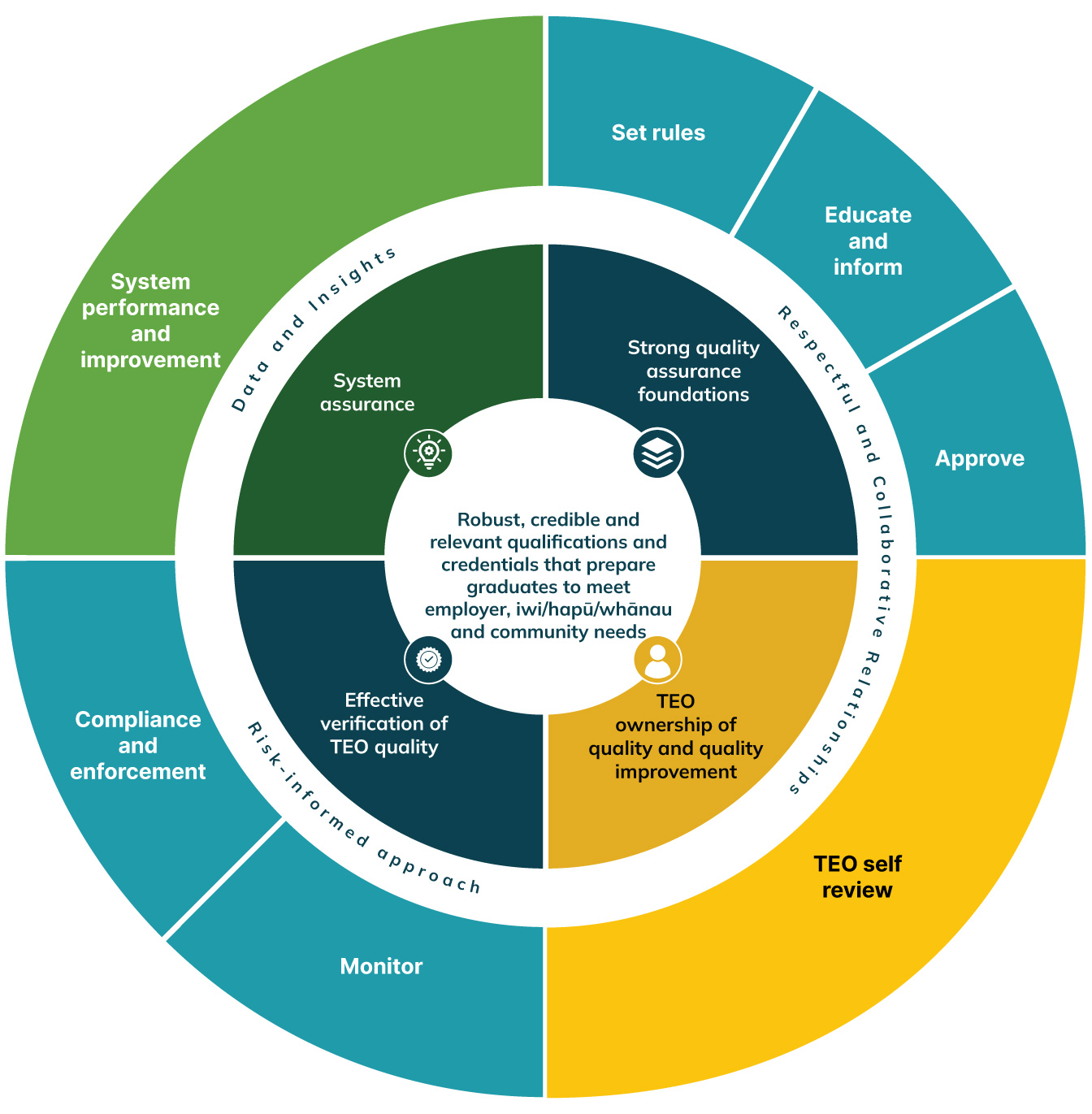
iQAF: what's in place
TEO self review: an update
The first TEOs to participate in TEO self review are progressing through the steps: 47 of the TEOs we regulate have now fully completed the review process. We’re evaluating how the process is going, and feedback so far has been positive.
If your organisation’s review is coming up, new introduction to TEO self review and self review summary report submission guidance resources are available to help - we encourage TEOs to view these videos and our TEO self-review webpages, or join our Q&A sessions.
We are offering drop-in online Q&A sessions to support TEOs to prepare for TEO self-review: an opportunity to meet with self-review evaluators and ask questions about the process. The dates and times for these webinars are:
- 6 October—12pm to 1pm
- 15 October—10am to 11am
You can register for one of these online sessions by visiting the NZQA events page. To support quality engagement, capacity is limited.
iQAF: what’s coming up
Describing provider quality
We consulted between August and early September on the development of quality descriptors to give learners, TEOs, government agencies and other stakeholders a clear and more nuanced picture of provider quality.
We are currently analysing the 61 submissions received. We will share the outcomes of the consultation and continue to work with the sector, peak bodies and other agencies before finalising the design.
Degree monitoring
NZQA is working through the future approach to degree monitoring as part of the iQAF. We will share more information with the sector in November 2026, including what the approach will mean for providers and how the transition will be managed.
Regulatory updates
Work-based learning and subcontracting arrangements
NZQA (alongside the Tertiary Education Commission) has completed targeted discussions across the vocational education sector to better understand current work-based learning and subcontracting practices. The engagement focused on clarifying definitions, understanding existing delivery models, and identifying any areas where current Rules may not align with sector practice.
We will share key findings and components of the Rules to be reviewed by the end of November.
Te Hono o Te Kahurangi review
We are continuing to review Te Hono o Te Kahurangi, our kaupapa Māori quality assurance approach for the non-university tertiary sector, to ensure it continues to support Māori educational success and reflects Māori ways of understanding and assuring quality.
Outcomes of the review will be shared with TEOs that use Te Hono o Te Kahurangi in October, and we will continue to engage to develop our regulatory approaches in line with the review outcomes.
Guidance on the acceptable use of AI
In parallel with the international multi-agency work exploring regulatory approaches to AI, we are committed to developing guidance on the acceptable use of AI in vocational education that considers both learner and educator use.
We are working with the ITENZ Assessment and Moderation Community of Practice to help us better understand how AI is being used across vocational education, including implications for assessment integrity and learner authenticity, and the role NZQA should play in supporting the sector's response to AI.
In case you missed it...
NZQA’s qualification certificate printing service ending
NZQA will discontinue its qualification certificate printing service for TEOs from 31 December 2026. This change applies only to the printing of qualification certificates for currently registered TEOs.
NZQA will continue to:
- process requests relating to qualifications awarded by de-registered TEOs where achievement verification is required, and
- print NCEA certificates.
Contact the Data Management and Learner Records team at dmlr@nzqa.govt.nz if you need support.
New Private Training Establishments (PTEs)
We have evaluated 14 applications for new PTEs this calendar year to date and registered 13 of these as new PTEs:
- Hair Industries Support Opportunities Charitable Trust 4447
- Kura Cares Charity 4431 (external link) (external link)
- Hermitage Education Limited 4448 (external link) (external link)
- QMS Audits New Zealand Ltd 20599 (external link) (external link)
- Institute of Sikh Studies NZ 20600 (external link) (external link)
- Unique Academy of Hair & Beauty Limited 4442 (external link) (external link)
- Connexis Inc 20605
- EastPack Limited 4450 (external link) (external link)
- SmartPath Education Limited 20612 (external link) (external link)
- Farm Skills Limited 20606 (external link) (external link)
- Kaitiaki Training Limited 20607 (external link) (external link)
- Te Hauora O Te Hiku O Te Ika Trust 20604 (external link) (external link)
- Tauranga Traffic Management 2023 Limited 20602 (external link) (external link)
Three former PTEs have also been re-registered:
Resources
NZQA webinars and information sessions
As above, we deliver webinars and information on a range of topics related to our work throughout the year. These are free and open to all providers.
Check out the NZQA events page to view our listing of upcoming webinars:
If there is a topic you would like to see us develop a webinar on, please let us know by email spc@nzqa.govt.nz.
Key dates
Dates for submitting information to NZQA are published in the Key dates section of the Quality Assurance Hub – a good place to start for the latest information on our requirements and regulatory practice.