

The risk-informed approach is one of the three enablers of the integrated quality assurance framework (iQAF).
Our quality assurance system for tertiary education organisations
We use a risk-informed approach for our quality assurance activities. This includes a structured model to:
- identify and assess risk to prioritise our monitoring activities and inform our approval decisions
- verify that tertiary education organisations (TEOs) comply with relevant rules, codes and standards for educational quality and learner wellbeing
- manage situations where TEOs don’t meet their obligations.
We use a risk-informed approach at all levels
We take a risk-informed approach to regulating the quality of education and learner wellbeing at the TEO level.
At the system level, we seek to identify emerging system risks to support TEOs in addressing them and to inform our regulations.
On this page
The risks that inform our approach
In the context of the iQAF, risk refers to TEO activities or wider system changes that could affect the quality of education or the safety of learners.
We have a responsibility to monitor those risks in our roles as:
- custodian of the New Zealand Qualifications and Credentials Framework (NZQCF) and the associated quality assurance functions
- administrator of the Education (Pastoral Care of Tertiary and International Learners) Code of Practice 2021.
About the New Zealand Qualifications and Credentials Framework (NZQCF)
The Tertiary and International Learners Code of Practice
The indicators of risk we use are identified through research and our regulatory processes. They are adaptable and responsive and may change over time.
What the risk-informed approach means in practice
We use the risk-informed approach for monitoring and approvals.
How the risk-informed approach works at the system level
Our risk-informed approach to quality assurance also operates at the system level.
We will act when our quality assurance activities identify non-compliance
We will manage non-compliance under the Compliance and Enforcement lever of the iQAF.
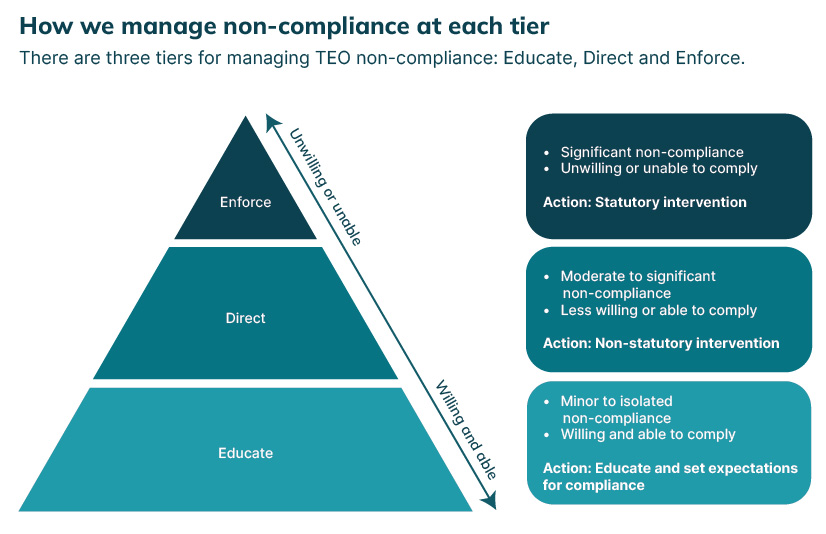
Educate
- Minor to isolated moderate non-compliance.
- Willing and able to comply.
Action: Explain requirements and share insights.
Direct
- Moderate to significant non-compliance.
- Less willing or able to comply.
Action: Share concern and/or set out required action.
Enforce
- Significant non-compliance.
- Unwilling or unable to comply.
Action: Take statutory action.
Our actions will address the nature and severity of the issue
The extent of our interventions will depend on the severity of the issue, whether it is repeated or a one-off, and the willingness and ability of the TEO to comply.
We expect that our proactive risk-informed practices and monitoring will identify most issues in a timely way and interventions will come mainly under the Educate and Direct tiers.