

2025 Outstanding Scholarship
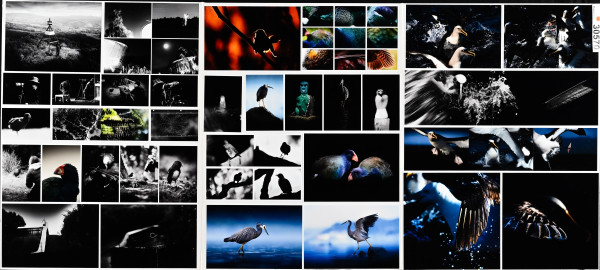
This Outstanding Scholarship portfolio showcases the candidate’s articulation of a compelling proposition that explores the interplay between the natural and constructed environments of the Orokonui sanctuary, presented through the conceptual lens “Orokonui: A Love Story.” The investigation is grounded in authentic personal engagement, informed by interactions with people, flora and fauna, ecological dynamics, interspecies relationships, and the diverse narratives that exist within the predator-proof sanctuary. The portfolio functions as a refined microcosm of the candidate’s photographic journey.
Research is extensive, insightful, and demonstrates intellectual rigour. Cultural understanding is intentionally sought through engagement with both people and whenua, resulting in contextual research that meaningfully supports the exploration of key conceptual ideas. The photographic practice is informed by a cultural and Te Ao Māori perspective, enabling a nuanced understanding of the local and semi-local influences shaping the Orokonui environment.
The candidate’s documentation reveals innovative and lateral strategies for photographing wildlife and natural settings. Purposeful use of natural lighting is evident, employed to examine colour, texture, form, and, critically, contrast. Connections to established practice are comprehensive, and the candidate’s readiness to engage in iterative experimentation illustrates a reflective and analytically driven approach to image-making.
Overall, the Outstanding Scholarship portfolio extends the scope of the portfolio by presenting a comprehensive and well-supported investigation. The portfolio and workbook evidence display a considered and fluent application of research, as well as a consistently high level of engagement with both the conceptual content and the photographic practice. Collectively, the depth of inquiry and sophistication of execution affirm the candidate’s capacity to operate at an exemplary scholarly level.
Download 2025 Outstanding Scholarship Photography workbook [PDF, 8.2 MB]
On this page
2025 Scholarship
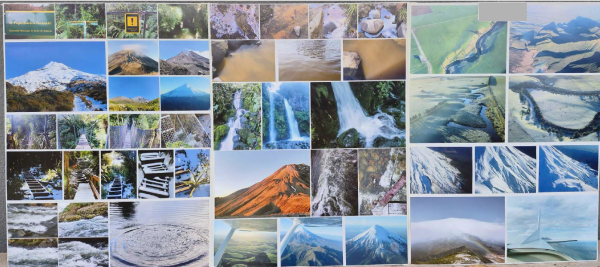
This Scholarship portfolio demonstrates compelling engagement with place and Tūrangawaewae, articulating a strong sense of personal belonging. The candidate employs a geographical lens to navigate the rivers that weave through the whenua and the enduring presence of Taranaki Maunga, Te Papa Kura o Taranaki, which stands as a guardian over the region. The resulting photographs communicate, with depth and sensitivity, the ways in which the candidate’s upbringing is shaped by whānau and lived experience.
Research is extensive, purposeful, and directly aligned with the candidate’s conceptual proposition, effectively informing their approaches to image making. Technical capability is evident through sophisticated use of time, light, atmosphere, and contrast to construct mood and emotion. A substantial suite of experimental explorations complements the primary body of work, employing diverse techniques and processes to investigate alternative ways of perceiving and representing the landscape environment.
The candidate demonstrates thoughtful consideration of conservation and its significance, reflecting personal connections to the environment from both ground level and aerial perspectives. Their commitment to predator free initiatives and biodiversity protection is captured with clarity, expertise, and confidence from elevated viewpoints.
Research functions as the driving force behind both image taking and image making. The candidate investigates a range of established practices to inform their photographic inquiry and outcomes. Their visual documentation reveals lateral, inventive approaches to photographing the maunga, using natural light to accentuate the powerful forms and contours of the environment.
Overall, this Scholarship portfolio extends the breadth and depth of the portfolio, presenting a coherent, well supported, and highly personal investigation. Across both the Portfolio and workbook of evidence, the candidate demonstrates sustained integration of research, content, and photographic practice.
Download 2025 Scholarship Photography workbook [PDF, 8.4 MB]
2024 Scholarship
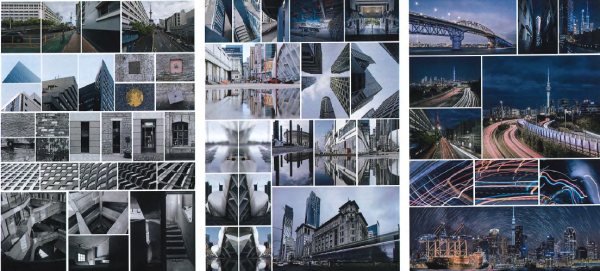
This Scholarship submission establishes the concept of the city and its moving nature through time and space. Coming from Shanghai and arriving in New Zealand, the candidate has a strong familiarity with cities and makes connections through their research to colonial history. Referencing ideas of the city to portray beauty that is often overlooked and
neglected, the candidate connects with research to investigate questions such as “is change always a good thing?” and “is architecture photography an art form?” Answers are presented throughout the photographic enquiry using different camera positions and creating photographs that demonstrate the ability to visually articulate buildings, cityscapes, and spaces.
The portfolio has a sense of “unrealising” and forming confusion for the viewer. This strategy employs a point of curiosity for the viewer as the candidate links this idea to M.C. Escher who assembles the impossibilities of space and time. The intention of the proposition positions an interest around the notion of cities and motorways, spaghetti junction, the busyness in a city, surfaces, and decay using the macro versus wide-angle lens. In the workbook, the candidate explains their process in curation of imagery by explaining conventions and references to established practice. An example is the images on Panel 1 that explore decay and deterioration and shift towards abstract surfaces of architecture.
There is a consistent level of analysis and insight to the local cityscape that has enabled the candidate to sustain an in-depth investigation into the natural world and the human-made infrastructure. The workbook contains work from behind the scenes that supports the sequences on the portfolio and forms a parallel commentary about the portfolio work, reviewing decisions about image-making, editing, and sequencing formations. The candidate presents a high degree of technical fluency on the portfolio with further work in the workbook offering experimentation and testing of conventions. There is breadth of engagement, skill in specific editing, and creative thinking within the proposition.
The handling of colour, composition, and lighting of different spaces within the city is sophisticated. The candidate does not rely on trying to create symmetry post-production but rather looks for it in the camera first. Tessellations move beyond the flips as they reference established practice but find purpose to change and own decisions made through research and investment in the project. Light is explored in depth with the move into changing shutter-speed settings to capture light trails within the city to portray the rotation of the Earth and its relativity to the stars. The juxtaposition of star trails balances the exploration of the natural world (star trails) with the human-made structures; the stars light up the city. The portfolio and workbook submission are driven by a photographer that is interested in the art of “looking”.
Download 2024 Scholarship Photography workbook [PDF, 2.9 MB]
2023 Scholarship
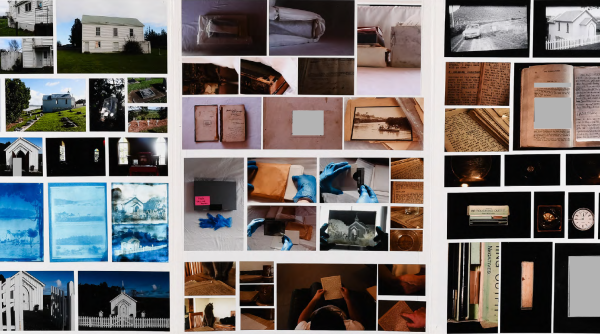
This Scholarship Photography submission focuses on sites of significance for the candidate and her whānau, setting the scene for their family migration story. Their investigation into this family history began at primary school (revisited in 2017, 2020, 2023). Utilising this familial search as a beginning point for a photographic enquiry provided many inroads to the nature of the unfolding image-making.
Seeking out stories and spending time in the town’s chapel, ‘imagining’ these spaces and places where their grandparents once sat, was a pivotal move in developing a connected relationship with the past. The workbook effectively documents the journey taken in honouring the family story through a mix of the candidate’s own conversations with family, recording and telling (written text and old photographs), and thereby establishing a modus operandi for seeking out new ways of seeing whakapapa in the context of their creative discovery process.
In conjunction with their pursuit to know more, the candidate started asking questions about aesthetics and collections. They understand the productive tension between the aesthetics of a handwritten mark, the fade of a well-worn page and the significance of holding an object once held by their ancestors. We know this via their own photographs on the folio and the accounts in the workbook. These were productive prompts for reflecting on family ephemera/printed matter, old photographs and artefacts found or gifted and how these elements/subject matter could be used to stretch out the imagined content across time. Due to the lived experience component of the enquiry, the project remained active and inquiring throughout. The candidate’s Nana was able to share various treasured objects, such as the family bible (containing a hand-drawn face) and two silver/gold pocket watches, which became the central subject matter for later photographs.
Various photography practices are employed; cyanotype, pinhole and darkroom (including stencils and glass negatives) position the work across and in time. Experimentation with non-digital processes conceptually supports their interest in looking into the past, such as using the pinhole camera to take a contemporary family portrait akin to the qualities of the historical family photograph and working with family-owned film slides and glass plate negatives. Incorporating these found images/processes into their own work trajectory created a rich layer to the work that both honours and makes the past present.
Links to artists’ work like Robin Morrison and Robert Frank inform processes and aesthetic decision-making. The candidate was analytical and thoughtful in how they engaged in their artmaking, in parallel with their ongoing experience of learning and knowing more through each iterative phase and artwork made. The folio work evidences an authentic journey through an articulately composed and well-executed body of practice.
Download 2023's Scholarship Photography exemplar [PDF, 17 MB]