2025 Outstanding Scholarship
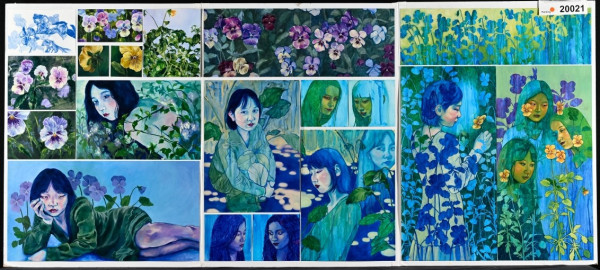
Thoughtful use of imagery and careful attention to detail form the foundation of this Outstanding Scholarship portfolio. The proposition is “Time through the transience of the present moment”. Aptly capturing thoughtful contemplation, the portfolio shows the candidate’s ability to explore and capitalise upon their discoveries using limited subject matter. Insightful research into pansy floriography (pensée) and deliberate decisions about pose, gaze and placement of the figures creates an evocative investigation where spatial arrangement and paint processes are used meaningfully to convey transience. The candidate’s approach to demonstrates focus and commitment to developing practical understanding as they refine strategies to balance representational space, pattern and design across each sequence. The portfolio demonstrates a range of practice towards understanding media, supported by carefully curated links to established practice which inform the development of paint processes and pictorial ideas. The portfolio and workbook relate strongly as dual sites of knowledge, documenting a learning journey throughout the year with evidence of concurrent exploration of content and concept in the development of the candidate’s ideas. Source imagery is authentic and is produced through exploratory drawing and photography integrated within the study both in class and at home.
Conceptually, the portfolio is well supported by inquiry that is carefully documented in the workbook. The candidate positions themself at the centre of the project and advances the proposition by asking related questions and returning to key drivers throughout the study. Wider links to literature are considered as the candidate becomes confident in creating symbolism to communicate ideas about feminine stereotypes, the impermanence of time and cycles within nature. Quotes from wider reading provide thematic connections that inform the practice, such as “Some things are more precious because they don’t last long”.
The candidate purposefully employs colour for effect and combines imagery to communicate moments in time. On Panel 1 they set out to create “an uneasy, deceptively alluring atmosphere” where tension and anxiety are communicated in the picking of a flower, and bright petals and leaves represent the flush of life before eventual decay. Artist models are carefully selected for their relevance to idea and technique. Hope Gangloff, Vincent van Gogh, John Singer Sargent, Amy Dury, Kehinde Wiley and Alphonse Mucha provide informative and purposeful study into colour theory, paint application, composition, pose and pattern. Critical thinking, synthesis and communication are clearly demonstrated as the candidate develops and refines processes to meet the high standard they set for themself. Trial and error, refinement towards mastery of technique and persistent attention to detail are consistent features in their drive to produce work.
Shifting pictorial space as a metaphor for time is supported by varied format, delicate transparency and positive and negative motif in the second half of the portfolio. Surface, light and an assured deftness of touch create affinity and juxtaposition within component parts of each painting, encouraging the eye to move across each composition before resting on chosen focal points. When viewed in its entirety, the portfolio benefits from thoughtful consideration of layout, format and colour consistency. The candidate demonstrates a range of approaches to paint processes and technique, skilfully advancing their understanding of the potential of the medium to express their ideas.
Download 2025 Outstanding Scholarship Painting workbook [PDF, 2.7 MB]
On this page
2025 Scholarship
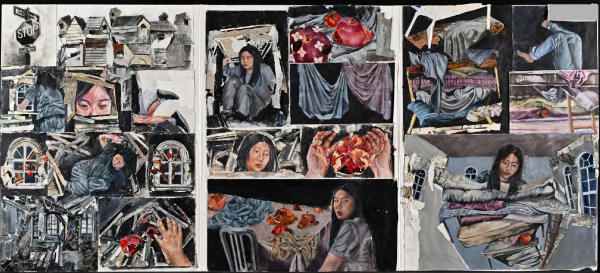
This Painting Scholarship portfolio presents an engaging study into process and media as a metaphor for self-discovery and understanding. The candidate positions themself at the centre of the study, investigating a range of options in a deliberately limited suite of motifs to communicate their ideas. The portfolio is inventive, experimental and reflective as the candidate evaluates and repositions themself in relation to their experiences. The workbook provides a clear and organised view into the candidate’s underlying motivation and intent.
The candidate develops a range of processes, imagery and motifs to communicate a sense of disquiet, movement and tension that reflects their exploration of identity. Explicit references to depicting different variations or types of self are deliberately avoided, as the candidate instead generates a series of visual metaphors to communicate self-critique and understanding. Formal relationships between process and subject are explored as surface, composition and materiality function both for their intrinsic visual qualities and as metaphors within their journey of discovery. Differing viewpoints and shifting scales and points of focus occur within and between sequences of work as the candidate extends their narrative intent.
References to Alice in Wonderland, The Princess and the Pea and Eve are incorporated meaningfully and with humour. The recurring theme of the apple morphs, becomes embellished, is placed in comparison with other fruit, shatters and becomes weightily overwhelmed as a metaphor for the teenage experience. In the workbook, the candidate explicitly refers to the apple as a deliberate choice for its universality and symbolism in “reflecting the complex journey of discovering one’s identity”.
Accident and discovery function as part of the candidate’s process and become a fitting metaphor for growth and acceptance of self, as the workbook shifts between establishing a proposition, struggling to gain control over skills and media, and engaging in reflection. Strategies are tested, considered, rejected and developed before being incorporated into the portfolio with intent. Focal point, leading lines, deconstructed spaces and juxtaposed surface textures engage the viewer and encourage movement in and around the pictorial space. Purposeful and relevant links to established practice and artist models are made in the workbook, and the candidate interprets these in relation to their intended study, choosing carefully which aspects to incorporate into their own thinking.
There is a clear sense of “hand and head” at work throughout the portfolio. The candidate poses questions for themself and seeks solutions to communicate their ideas in a variety of formats and viewpoints. The portfolio is consistent in its approach and considered in its layout. The restricted colour palette allows focus on refining skills and creating opportunities to develop and expand the possibilities of surface. The proposition is located within the candidate’s own experience, while the limited iconography enables pictorial exploration in developing an authentic aesthetic without undue reliance on external imagery.
2024 Outstanding Scholarship
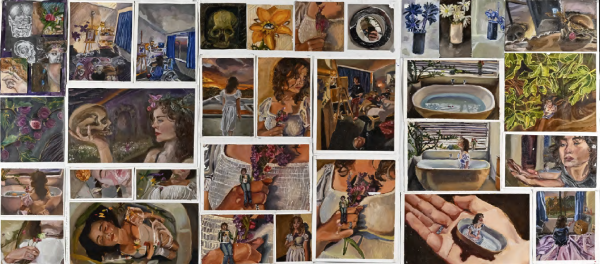
The proposition for this Outstanding Scholarship Painting submission was to “use self reflection to explore the human condition.” As a contemplative project using a restricted scope of self and personal surroundings, specifically home, this submission provides in-depth analysis combining literary and artistic references to create technically fluent and
confident paintings. Early in the enquiry, the candidate identified a range of painterly approaches they wished to integrate into their practice, alongside particular pictorial and thematic strategies.
The development of original and authentic source imagery via staged photography was supported by a range of established artist practices, which have been carefully chosen to support the theme, scope, and context of the study.
Choices around colour palette, development of surface, lighting effects, and point of view are supported by close analysis of artist reference, which include James Ensor, Caspar David Friedrich, Michael Chevel, and Jacqueline Fahey.
For the candidate, this presented an opportunity to locate themselves within a range of practices to construct a sense of their own narrative. Planning and careful development of composition is evident in this submission as the candidate crafts their paintings. Narrative approaches and literary allusions abound as the candidate confronts the vicissitudes of being. Established visual techniques of Rückenfigur, festaiolo, and mise-en-abyme are thoughtfully employed in image-making, while shifts of scale, pose, and gaze allow the viewer to gain insight into the central character. The
candidate describes this as exposing the “raw vulnerability” of themself. By searching for symbolism in the mundane and commonplace, and literal reference to the self, this enquiry creates a particular sense of introspection. The narrative shifts between points of view, looking at and looking with the artist as multiple representations of self, environment, and the passage of time swing between the whimsical, imaginative, and mundane in an increasingly
dreamlike state.
A strong technical exploration into oil painting processes has taken place and is supported by the workbook. Colour and surface decisions are underpinned by various mark-making strategies dealing with paint consistency to achieve a particular outcome. This has been expertly employed where the candidate skillfully combines gestural brush marks and impasto with blending, glazing, and overpainting to vary the pace in and between phases of work. Focal points are carefully controlled within individual artworks where brush shape and size, weight, and speed of paint application have been carefully considered. Textured and activated surfaces act as a counterpoint to more detailed passages that allow the eye to travel, and rest, in paintings. The generation of images is strongly established in a process of thinking, trialling, and construction where sketching, photography, and digital collage are employed to create meaning within and between works.
Download 2024 Outstanding Scholarship Painting workbook [PDF, 2.7 MB]
2024 Scholarship
This Painting Scholarship submission demonstrates a sophisticated, personal inquiry exploring bi-cultural and multi-cultural concerns. The candidate positions themself at the centre of the study, investigating commonalities between cultures, symbolism, and imagery in a post-colonial Aotearoa New Zealand context. There is a high level of engagement and understanding in the workbook and folio, where the candidate develops well-considered
strategies to convey their ideas.
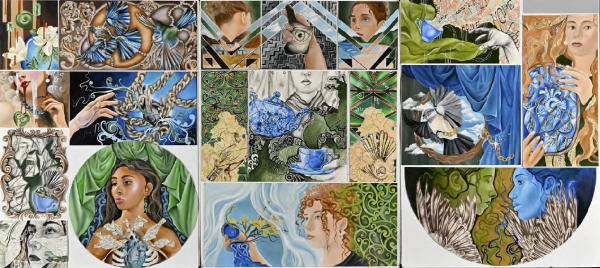
The candidate researches and develops a range of symbols and motifs in their drive to eventually create works that will communicate cross-cultural harmony. Intentional references to damage are made in the initial stages of the project in the form of a smashed mirror and broken pounamu, deliberately employed to allude to Aotearoa New Zealand’s colonial past. Decorative elements of rococo carving and pearls, employed to suggest an imposed European aesthetic, are juxtaposed with native birdlife, landforms, tukutuku, and kōwhaiwhai, which are referenced to represent the natural beauty and established cultural narratives within Aotearoa New Zealand. Panel 1 culminates in a large work that combines Renaissance religious symbolism with distinctly Māori iconography. In this work, a young wahine is depicted to personify beauty in a cross-cultural context. She is surrounded by sumptuous green fabric and blue kōwhaiwhai with an “immaculate heart”, a reference to biblical Mary showing love and compassion for humankind; an icon for a harmonious future.
Subtle and purposeful juxtapositions are made throughout the submission, which are reinforced with solid research and exploration within the workbook. Artist models, movements, and techniques are combined with research where the candidate has visited sites of personal significance. References to Māori and other cultural motifs are employed
with sensitivity as the candidate explores ways to communicate a contemporary multicultural Aotearoa New Zealand. Kōwhaiwhai motifs, including mangōpare and koiri, are combined with topographic contour lines to suggest the strength and nurturing of the whenua, and Japanese kintsugi repairs the distinctly British signifiers of teapot and cup.
Varying approaches to media, processes, and format are explored by the candidate and are used purposefully where the form of the artwork matches its meaning. Collage works are explored to capitalise on tearing, cutting, and sticking together, both as a technique and as a metaphor within the visual language. Images are thoughtfully constructed and produced with high technical facility, aligning subject and atmosphere to communicate ideas with clarity. Motifs are advanced, repeated, and re-framed at each stage of the process to create passages of movement and stillness.
In the early stages of the proposition, the candidate states clearly their intent in key statements: “Personal point of view as a young female Pakeha” ; “Analyse the conflict in New Zealand’s history” to explore the “harmony that could exist” and to “explore New Zealand as a multi-cultural society and...my place as a European New Zealander in that society”. As such, this submission is an authentic and refined personal investigation. It is thoughtful and analytical, and seeks to communicate issues of importance.
2023 Outstanding Scholarship
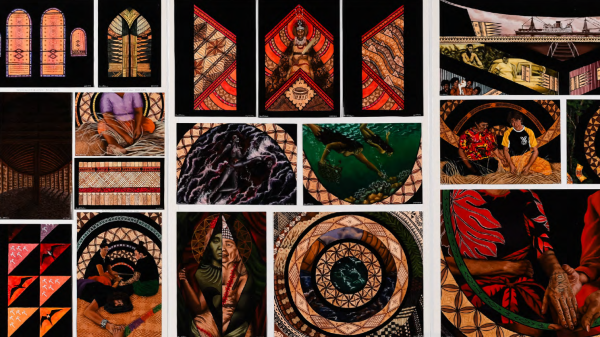
The premise of this Outstanding Scholarship Painting submission was to depict faʻasamoa, faʻasinomaga (Samoan way of life, Samoan identity) and share the “beauty and complexity” of everyday practices and traditions through the candidate’s diaspora lens. As a personal project about identity (they identify as a queer, New Zealand-born Samoan), the candidate is deeply invested and engaged in the proposition, which they negotiate through solid, in-depth research and integration of their thinking into technically expert paintings. From the outset, the folio works interweave complex pictorial strategies that provide navigation for the storytelling and signifiers utilised.
The artwork is beautifully rendered and powerful in its visualisation. Intentionality is a vital factor in the conception of the paintings and analysis of motif and compositional structure. The candidate utilises symbolism to situate their culture as the subject matter and vehicle; architectural references such as the shape of the fale tele enacting the sky (heavenly / biblical association) or the use of tatau to communicate the story of their grandparents’ immigration to Aotearoa from Samoa. All visual aspects are considered equally: line, tone, pattern, figurative, perspective, paint stroke, and colour palette.
Artistic reference is excellent; the range of practices from senior artists to younger generation practitioners serves to provide a community of voices and an apt neighbourhood of contextual references. The candidate investigates Christian art, historical representations of sacred subject matter, traditional processes of tatau, lalaga, siapo, fale, siva, and images of ancestors and family to create imagery that speaks to Samoan culture. For the candidate, this approach to traditional art forms and histories addresses the influence of colonial forces in Samoa and their own “feelings of inadequacy and disconnection, being culturally assimilated, being disconnected from the church, and being queer”.
The workbook documents a thoughtful, well-researched, and critically focused journey. At every step, they are self-reflexive about previous steps taken and consider how learnings can be utilised to make the following passage of work. They combine the personal with collective and inherited knowledge; the workbook intelligently frames the candidate’s line of questioning. Throughout the enquiry, they discuss the selection, relevance, cultural significance, and meaning of symbols in both their own artwork and historical contexts. The methodology is thorough and holds close to the candidate’s intent to make work exploring their familial history through symbology and pattern.
The folio layout is structured incredibly well. There is a symmetry and rhythm to the linear and patterned compositions reinforced by the movements between the individual artworks of the stained-glass works and the images of Samoan people / family (ancestors and themselves) performing and making. This is an important aspect in the communication of faʻasamoa and faʻasinomaga and the cultural value placed on performance and crafting, intergenerational knowledge and making by hand. The folio paintings skilfully communicate a celebratory honouring of Samoan culture and the candidate’s story.
2023 Scholarship
This Painting Scholarship submission presented a sophisticated self-portrait and personally relevant enquiry about gender fluidity. A high level of engagement and ownership is present in the folio and workbook. Holistically, these two sites of evidence combine to engage in an intensive exploration of self and identity.
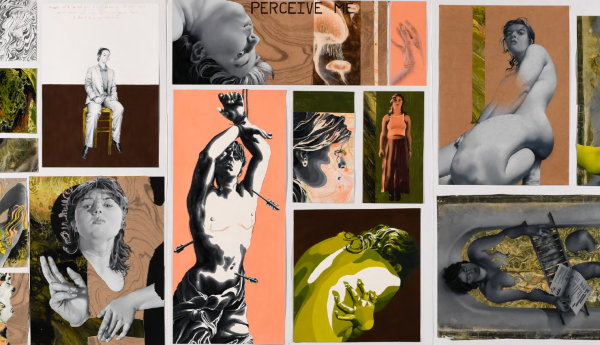
The candidate employs compositions and figurative elements from other artists’ works, such as Frida Kahlo, rendering their own image in Kahlo's androgynous persona in Self-Portrait with Cropped Hair, 1940. This symbolic gesture affirms their own story and representation of “transgenderism”. In the portrait, raw handwritten words of perception hover above them as they hold a pair of scissors (also commenting in the workbook that “Mum kept my hair”), whereas Kahlo’s hair lies strewn on the ground. This work is an influential piece; it is a signifier of the beginning of their “transition and freedom from binary perception”, characterising this moment as an emotive expression of their resentment of such perceptions.
Artistic references are carefully selected and well-utilised and make sense of their chosen strategies and devices used to create the controlled and complex folio works. They also look to Rita Angus’s paintings as an example of masculine-styled portraiture; Guido Reni’s Saint Sebastian, created in 1620–1639, to convey ideas of transgender persecution; and Jacques-Louis David’s The Death of Marat, 1793, to speak of their personal loss and betrayal. The adaptation of these artists’ work as a kind of metaphoric symbology is powerful and communicates the determination and strength of the candidate’s willingness to share their stories.
Every media process, motif, and stylistic characteristic is a representative part of the candidate’s identity and lived reality, such as the collagic, fractured compositions to confuse the portrait structure, the inclusion of top surgery scars on a traditional figurative pose and the birth certificate held in their hand in the bath. Colour is a crucial symbolic and representational element utilised to embody their frustration and pain, thus introducing olive green into the palette to give the works a murky and ill-at-ease edge.
The candidate understands the fluidity of paint media to represent gender fluidity (a symbol of their fluid state). They employ methods such as marbling that rely on unpredictability and chance patterning to create abstract compositions, blocked areas, and motifs in paintings. The direct nature of the painting compositions, poses, perspective, and the rawness of media is well-handled; we are left with no doubt about the candidate’s feelings and state (body dysphoria, dissociation). The blank stare that persists throughout the works assumes an immediate challenge to the viewer; they are asking for respect and want their art to provide comfort for their community, stating in the workbook, “I want it to impact your thoughts on queer identity and the boxes constraining it within your mind.” This painting submission is an original and self-determined Scholarship exploration of trans identity and experience that is technically refined and mature in its synthesis and perspective.